
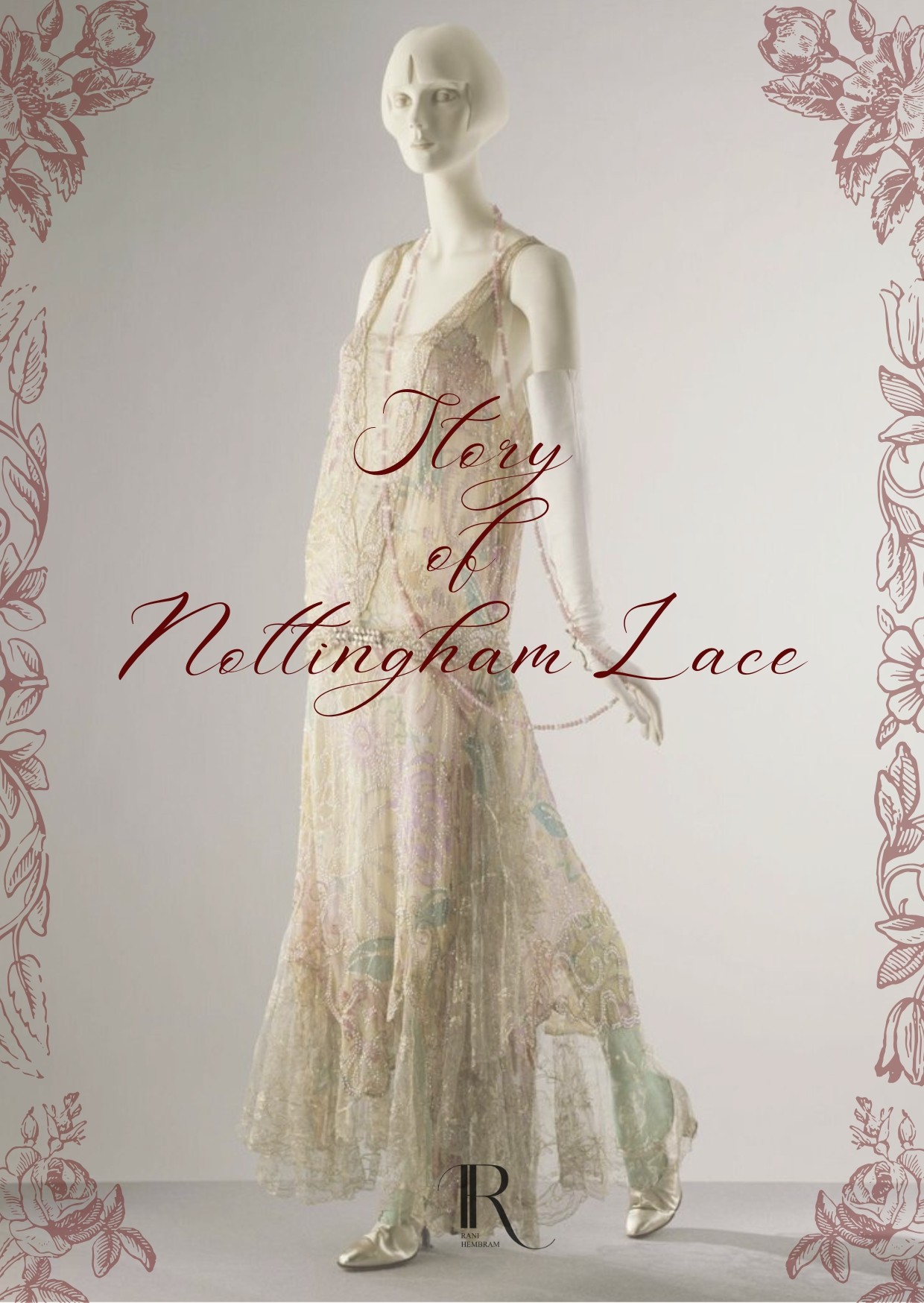
Mystery & History of Lace Market !
I love how mysteriously things always have a way of coming back to us ; when I first started exploring Nottingham “Lace Market” - this name always stood out to me ; I was genuinely curious to know whether that’s just a name or actually its a market where pretty Laces are sold ! Well turned out its just a name ! But still, why the name ‘Lace Market’ … anyways days passed and I forgot about that bit until the day before yesterday when i decided to get a booking and visit ‘The Lace Archive’ at Bonington Building of my uni (NTU).
‘Jayne’ was at the Lace Archive who was telling me about all the information about various kinds of laces and that’s when she revealed Nottingham wasn’t known for handmade lace in the traditional sense. Instead, it became famous for the invention of lace-making machines. And those laces which were made in Nottingham were sold and traded at the “Lace Market” and that’s where the place gets its name from and even though today none of that happens there the name still stands and this lit up the bulb of my brain ! She told me those machineries could still be seen today in the ‘Nottingham Industrial Museum’ , well well … have to plan a trip someday !
Isn’t it amazing that lace, something so expensive, delicate, handmade, and reserved for royalty or elites (especially in early France) : was reimagined here? Some genius in Nottingham decided, nope, lace should be for everyone… and created machines to make that possible. To be honest, making lace accessible to all is commendable, and Nottingham did an incredible job. But somewhere, I find myself a little conflicted.
On one hand, this shift was revolutionary. Lace, once reserved for the elite, became accessible to the masses. Nottingham didn’t just produce lace, it redefined who lace was for.
But on the other hand, I couldn’t help but wonder ~ what gets lost when something so intricate becomes mass-produced? When everything becomes quicker, more polished, more identical… does it lose that human touch? Does it still mean the same?
The Lace Market, I learned, was at the heart of this booming industry. It wasn’t a place where lace was casually sold - it was a hub of production, trade, design, and global exchange. There were strong trade connections between Nottingham and places like New York, where lace became part of a wider fashion economy. I even saw buyer’s books : records of transactions, tastes, and trends ! So we’re not talking about one or two machines; there were many companies and thousands of machines. Which brings me back to my question: is accessibility more important than intimacy?
One book I saw was dated 1926. Standing here in 2026, it suddenly hit me - this object was exactly 100 years old. And today almost everything is mass-produced not just ‘Lace’ ; we need everything quickly ! High demand , quick pace and Lost intimacy ! I guess that’s the world we live in now ! And maybe with time we need to learn to Love new ways , we can’t really be stern and stick to past but that doesn’t mean we forget our roots and stop cherishing our past.
And that’s why I loved this archive visit. People in Nottingham still cherish their past. They preserve it, archive it, and allow it to be revisited over time. Jayne showed me so many pieces of heritage lace clothing : gloves, collars, headpieces etc. all donated by people who wanted to preserve their ancestors’ belongings. It was surreal to see and even touch them. I was also shown how to distinguish between handmade and machine-made lace. Handmade lace carries tiny irregularities: knots, threads looping back, a visible human touch on both sides. Machine-made lace, on the other hand, is more uniform, often with “floats” i.e threads that run across to create patterns through mechanical repetition, usually more defined on one side.
Anyways… at last, my confusion about the “Lace Market” is finally solved and now I’m happy 😊
Do let me know, what are your thoughts on Mass production taking over handmade , is fast paced practicality more important than slow, one-at-a-time creation?

